
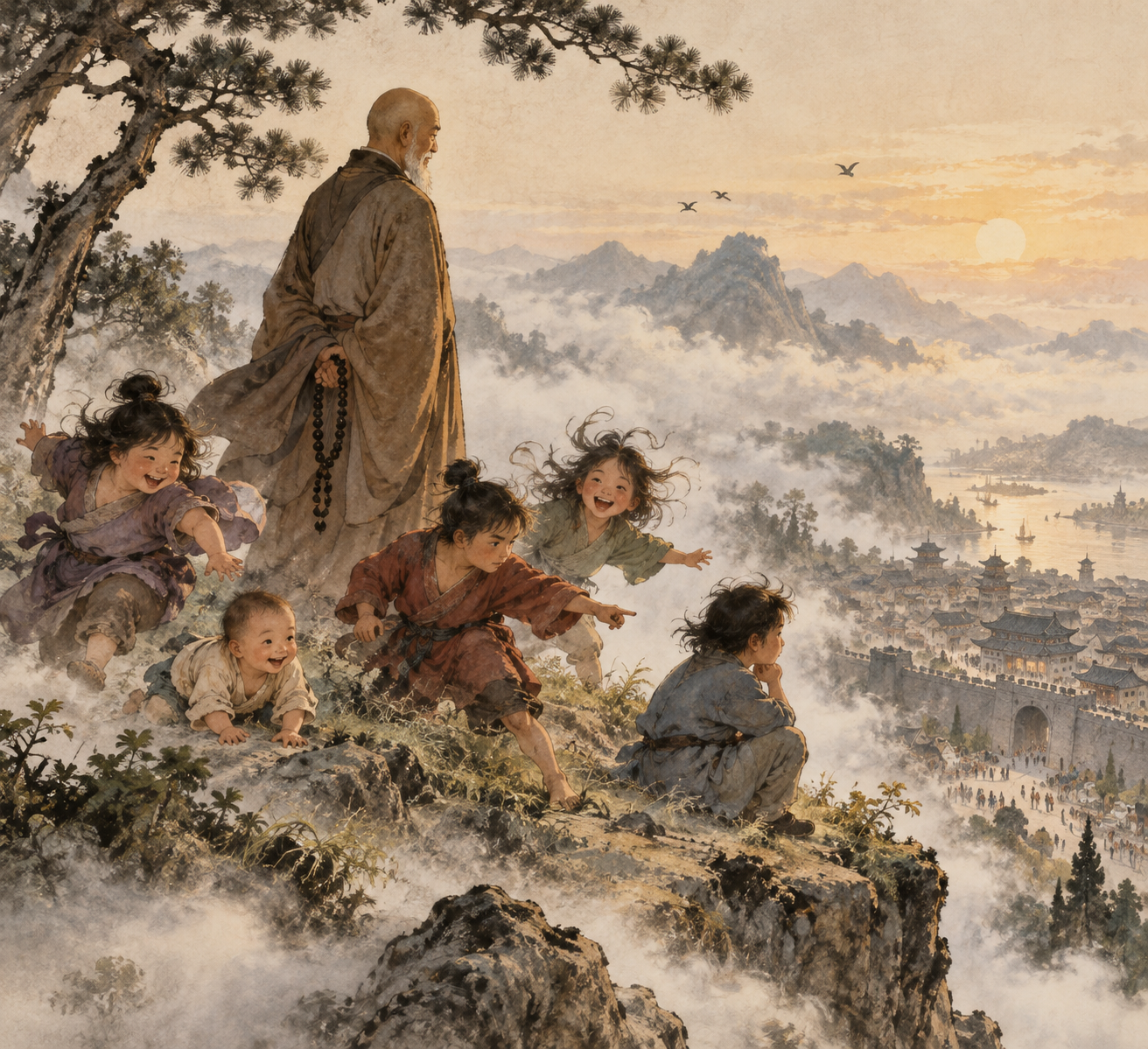
The lonely monk would sometimes walk along the cliff tops just outside the city. People would look at his shaved head and hear the clinking of his prayer beads when the breeze blew well, and they would wonder who he followed, and ask each other, “What school does he belong to?” and “What tradition does he practice?” No one was sure, but there was a rumor he was quite dull and orthodox, though no one could remember who first said that.
This old monk seemed dry and aloof. He didn’t go into town much, and he certainly didn’t have much to say. They sensed a certain compassion in him, but he didn’t seem to care about them much either. He perplexed the good folk, and they preferred the monks of the Do-Good Temple, who brought them food, or the nuns of the Feel Sweet Chapel, who sang them lovely hymns to lull them to sleep.
The old monk had all the trappings of a fine holy man, and he cast a shadowy sense of calm and alluring mystery, but he still made the people uneasy; though they knew he was there (though, strangely, not exactly), they kept their distance. They suspected he probably lived in a cave with wild beasts and night terrors.
All they really knew of him was his name, Master Who. He never said much more. Master Who knew there was nothing much else to say.
But for all the misty enigma that shrouded his way, Master Who was, in fact, a loving father. His five children often thought him stern, but they always trusted him to be there, never far if they briefly turned from their play to look. They knew he loved them and would always be right there the moment they needed him.
The silly children didn’t know it, but Master Who knew all their dreams, their visions, their aches and pains. He knew their fears, and he knew when to tell them to stop, especially when the elder children bullied the younger ones. He did it with love and wisdom, knowing the bullies were only hurting themselves, and the bullied still had much to learn. But he rarely did even that, trusting them to their own little scrapes and joys.
He would laugh at them, fondly, and call them his little Wu Yun, or sometimes his little heaps. Heaps of what? Heaps of mischief, most assuredly!
Though the five children rarely knew what they were doing, nor where they ventured to, the old monk kept a quiet eye, ever present, and when they became most willful and rambunctious, he would sing an old song they remembered, and with wide and outstretched arms he would gently gather them home where they would briefly rest. And in those precious moments of calm, they would look into Master Who’s ancient, twinkling eyes, and he would look into theirs, and then everything would be just … alright.
Like it was meant to be.
And when the children melted into the bliss of his embrace, folded into the warm comfort of his arms, Master Who would gently arise and disappear, leaving them content, asleep but vividly aware, all in love with each other, breathing gently, gently, as one.
If the city folk were ever to see these wild and unruly children smiling tenderly and at peace, they would wonder how Master Who cast such a spell on them. Surely these could not be the same children that terrorized the outskirts of their tidy town, spilling all the beans and letting the cats out of the household bags?
There was Rupa; she was the eldest, and though the old monk loved her, he knew she wasn’t the brightest of the brood. Always eating too much and complaining of stomachache. Running into trees, falling into bushes, coming home with scrapes and bruises on her small body. She would get frustrated at her younger siblings; didn’t they realize she was the boss? Silly little kids, she would often fume.
Vedana was the youngest and barely more than a baby. He didn’t know much; he just knew what he liked and what he didn’t, crawling toward or away from whatever his elder siblings were up to. Sometimes they shouted at him, and he cried, but then they threw him little sweets, and he giggled and gobbled them up with a happy, wet grin.
Samskara was the second oldest, and he felt deeply. He was born like that, opening his eyes at birth and somehow already knowing. But he was moody and liked to tell the other children what they should and shouldn’t do. He just thought he knew best; he always had. And the other children generally let him, as he so often seemed strangely accurate in his warnings and forecasts. They really wouldn’t know what to do without him.
Little Samjna was the second youngest, and if the other children were honest, she was probably the most annoying, though they loved her dearly and could never manage any sort of game without her. She brought all the fun and interest to their play. They just wished she would, well, shut up sometimes and stop being such a know-it-all.
The last was Vijnana. Always the first to wake up, ever the last to sleep. He was always watchful, never sure quite where he sat in the pecking order, but you could never put anything past him. Sometimes the other children thought old Master Who favored him a little more than them, but perhaps that was just because little Vijnana paid more attention to their father than the others did.
But they all played happily together; no matter how cross they became, they rarely strayed from each other, even if they didn’t know where Master Who had gone (but he was always right there, if they needed him).
And they were often naughty. Truth be told, they were usually naughty. But the old monk never got angry with them, never shouted at them. He knew their games would teach them or punish them, in their own ways. He had nothing really to tell them, and they were all happy with that.
Never as happy as when they heard his call-song, and he opened his arms wide, and they ran to him, and relaxed. And sleep and dream in sparkling diamond-like vision.
And the city folk would ask in wonderment, “Who is Master Who?”
He answered them once, when the Do-Good monks were late with their breakfast, and the Feel Sweet nuns had gone home, but they weren’t satisfied. He was very unsatisfactory. All he had responded with was:
“Who wants to know?”